

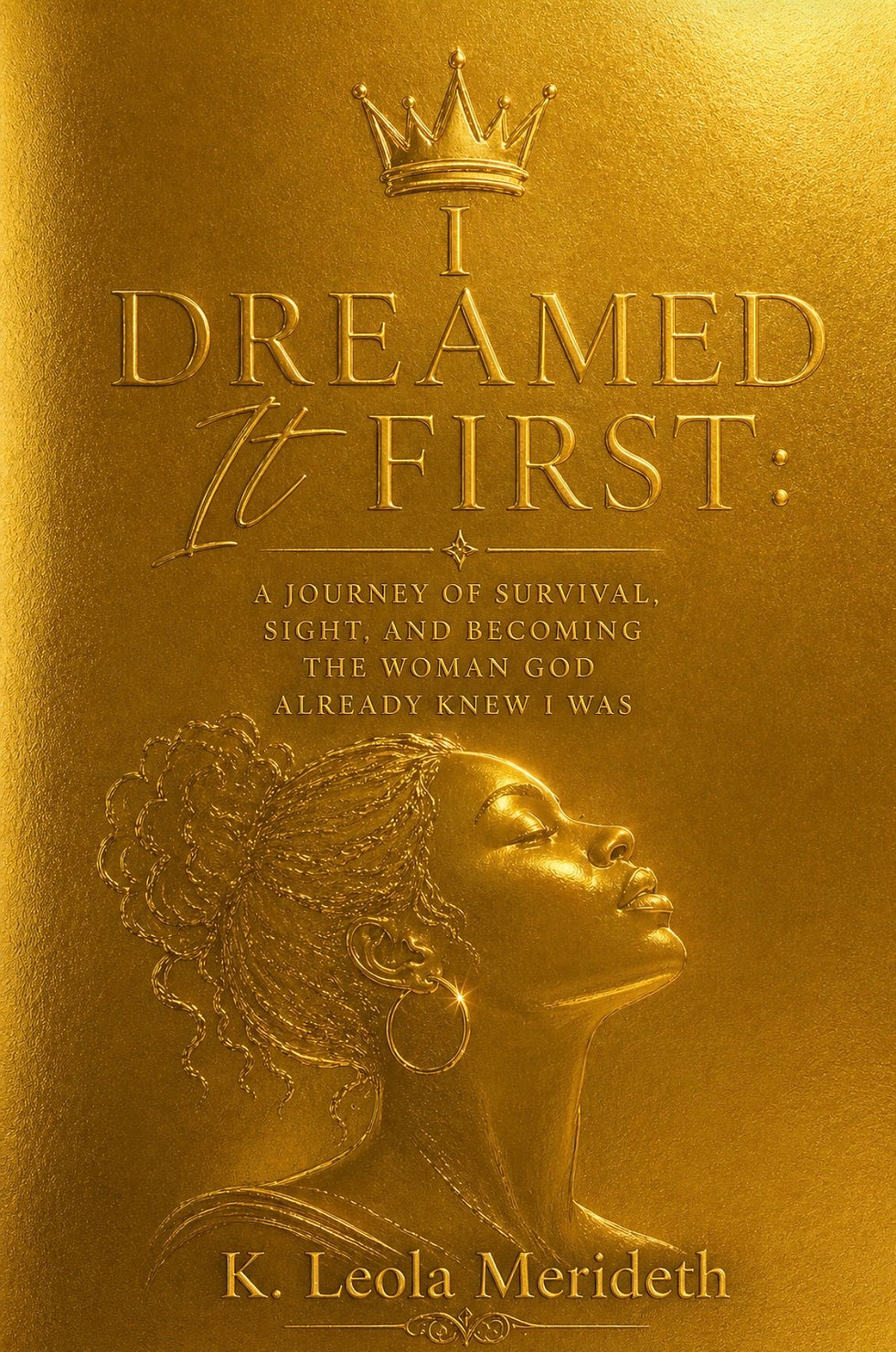
I Dreamed It First A Memoir of Intuition Healing and Power
Some stories arrive quietly. Others feel like they have been waiting for the right person, the right season, and the right kind of courage to be spoken.
K Leola Merideth’s, I DREAMED IT FIRST, belongs to the second kind.
This is a memoir rooted in memory, spirit, womanhood, and the strange, sacred knowing that can live inside a person long before she knows what to call it. Raised in Mississippi in the 90s, Merideth grew up in a life that appeared stable and full. She was loved. She was protected. She was seen.
Yet beneath that visible life, another story was unfolding.
Before she had language for intuition, she was experiencing it. Before she could explain the dreams, the visions, the inner warnings, and the moments of knowing, they were already shaping her. I DREAMED IT FIRST follows that journey with honesty and force. It is a spiritual memoir about healing, identity, and returning to the self after years of questioning what the self already knew.
It speaks to every woman who has ever softened her voice to make others comfortable, ignored a gut feeling to avoid seeming dramatic, or wondered if her sensitivity made her “too much.”
You are not too much. You are powerful. And this book will remind you of your strength.
A memoir that begins beneath the surface
At first glance, the early world of I DREAMED IT FIRST is not built on obvious lack. This matters.
Many memoirs of awakening begin with rupture that everyone can see. A public failure. A visible loss. A family fracture. A body in crisis. Merideth’s story, as described, begins in a more complex place. Her childhood in Mississippi held love and protection. It had structure. It had people who saw her.
That kind of beginning adds depth to the memoir because it refuses a too-simple story of pain. It makes room for a truth many people recognize but rarely say aloud: a person can be loved and still be carrying a mystery. A home can be stable and still contain questions no one knows how to answer. A child can be cared for and still feel something moving inside her spirit that adults cannot name.
The Mississippi setting adds emotional weight. The South carries deep layers of history, family ties, faith traditions, silence, survival, and inherited strength. To grow up there in the 90s was to live inside a place where community could feel close, where family memory often lingered, and where spiritual language might be present even when private experiences remained hard to explain.
For a young girl sensing things ahead of time, the world could feel both familiar and strange. The known life and the unseen life existed together.
That tension is one of the strongest promises of the book. Merideth is not simply recounting what happened. She is tracing how an inner gift began to reveal itself while she was still becoming a person in the eyes of everyone else.
Intuition becomes a language of survival and self-trust
One of the most compelling parts of this memoir is its focus on intuition before explanation.
Many people do not grow up being taught to trust what they sense. They are taught to be polite, agreeable, rational, careful, quiet. Women, especially, are often expected to provide proof before they are believed. If something feels wrong, they may second-guess themselves. If something feels destined, they may downplay it. If they sense a truth before others see it, they may tuck that knowing away.
I DREAMED IT FIRST confronts that pattern.
Merideth’s experiences of seeing things before they happened are not treated as a side detail. They sit near the heart of the story. They shape the central question of the memoir: what happens when a woman learns that her inner knowing is not a flaw, but a source of power?
That question has spiritual meaning, but it also has everyday meaning.
Intuition can show up as a dream. It can also show up as a tightening in the body, a repeated thought, a sense that a conversation is not honest, a pull toward a place, or a quiet certainty that something is about to change. Not every feeling is prophecy, and not every fear is wisdom. Still, the book’s emotional force comes from the idea that some forms of knowing deserve respect before the world can validate them.
For readers who have ever dismissed their own instincts, Merideth’s story offers a different path. It suggests that healing begins when a person stops treating her inner voice like an interruption.
Self-trust is not arrogance. It is a form of return.
The power of being loved and still needing healing
A striking part of the book’s premise is the presence of love.
Merideth was raised in a life that looked stable and full. She was loved, protected, and seen. That detail may seem simple, but it carries a quiet challenge. It reminds us that healing is not only for people who were denied care. Healing is also for people who were cared for, yet still had to make sense of fear, difference, calling, silence, and uncertainty.
This is a more honest view of human life.
Love does not erase every wound. Protection does not answer every spiritual question. Being seen by others does not always mean a person fully sees herself. A child can be cherished and still grow into an adult who must reclaim the parts of herself she hid, doubted, or misunderstood.
That kind of healing is often subtle. It may not look like a dramatic escape. It may look like finally admitting, “I knew.” It may look like naming the gift. It may look like forgiving the younger self who stayed silent. It may look like letting go of shame attached to sensitivity.
This is where I DREAMED IT FIRST becomes more than a personal account. It reaches toward anyone who has ever carried a private truth and wondered if it was safe to speak.
The memoir seems to ask:
What parts of yourself did you learn to question?
Who taught you that your intuition was too intense?
When did you first know something and talk yourself out of it?
What would change if you believed the quiet voice within you?
These questions are not abstract. They sit close to the body. They ask for honesty.
Merideth’s story gives those questions a human shape.
Reclaiming identity means refusing to shrink
The phrase “too much” has followed many women through life.
Too emotional. Too sensitive. Too spiritual. Too direct. Too aware. Too intense. Too hard to understand.
By naming that wound, I DREAMED IT FIRST speaks into a familiar pressure: the pressure to shrink.
Shrinking can look respectable from the outside. It can look like being easy to deal with. It can look like staying quiet in a room where something feels wrong. It can look like smiling through discomfort. It can look like calling a gift a coincidence because a gift feels too heavy to claim.
But shrinking takes something.
It takes language. It takes confidence. It takes the body’s natural signals and pushes them underground. Over time, a person may begin to feel disconnected from herself. She may still function. She may still be loved. She may still seem fine. Yet something inside her knows she is living below her true size.
Merideth’s memoir appears to move in the opposite direction. It is a reclaiming. Not a performance of power, but a return to it.
There is a difference.
Performance asks for applause. Reclaiming asks for truth. Performance tries to convince others. Reclaiming begins when a person no longer needs permission to name what she knows.
That is why the book’s spiritual focus matters. The spiritual life is not only about signs and dreams. It is also about identity. It asks a person to stand honestly before herself, before God or the divine as she understands it, before her history, and before the future she senses but cannot yet prove.
To reclaim power is to stop apologizing for the way truth arrives in you.
Why this story matters now
I DREAMED IT FIRST arrives in a culture where intuition is often either romanticized or dismissed.
On one side, people may treat intuition like a trend, something pretty and vague. On the other side, they may reject it as irrational. Merideth’s memoir offers a more grounded space. It places intuition inside a real life, with family, memory, place, fear, faith, and growth.
That grounding matters because spiritual gifts do not appear in a vacuum. They arrive inside human lives. They have to be lived with. They can confuse a child. They can challenge a family’s understanding. They can become part of a woman’s identity long before she is ready to speak about them out loud.
A memoir like this gives language to the in-between space.
It also matters because many readers are hungry for stories that honor both tenderness and strength. Not strength as hardness. Not healing as a perfect ending. Not spirituality as an escape from real life. Rather, the kind of strength that grows when a person looks back honestly and says, “There was more happening than I understood.”
That statement can change everything.
When a woman tells the truth about her inner life, she gives others permission to examine their own. Not because every reader will share the same gift or life experience, but because truth has a way of waking up truth.
The book’s title carries that energy. I dreamed it first sounds like recognition. It sounds like someone looking at an event, a pattern, a calling, or a future and realizing the spirit had already whispered it.
It is bold, but it is not empty. It names the experience of knowing before knowing was allowed.
A spiritual memoir for women learning to believe themselves
The deepest audience for this book may be women who are tired of doubting their own inner voice.
That does not mean the memoir excludes others. A powerful personal story can reach across gender, background, and belief. Still, the heartbeat of this book clearly speaks to women who have been told, directly or indirectly, to be smaller than they are.
Women who have heard “you’re overthinking it” when they were sensing danger.
Women who have been called emotional when they were telling the truth.
Women who have confused peacekeeping with goodness.


Comments